Wednesday, November 11, 2009

Veterans Day, All Gave Some, Some Gave All


© History Chasers
Click here to view all recent Searching for the Lost Colony DNA Blog posts

Bookmark and Share

Sunday, November 8, 2009

Presentation Nov. 10th, Tues. The University of North Carolina at Pembroke


Mary Livermore Library – News and Events

The University of North Carolina at Pembroke

The Friends of the Library invite you to join us Tuesday, November 10 at 7:00 p.m. for Richard Folsom, author of Indian Wood, A Mystery of the Lost Colony of Roanoke Island. Mr. Folsom will share his research into the oldest mystery in the country. Reception will follow.

Product Description

In 1587, Sir Walter Raleigh sent 116 men, women and children to Roanoke Island on the Outer Banks of North Carolina. They were to plant the first English colony in the New World. By 1590, they had disappeared. The colony was lost, and it remains America's oldest unsolved mystery.

Carl Bowden, a university professor, has discovered a document that may prove an intriguing new theory of what may have happened to the colonists. He made one phone call to a trusted colleague. Three hours later he was found murdered under the rotunda of the university library. Someone does not want the mystery of the Lost Colony to be solved and is willing to kill to protect the secret.


© History Chasers

Click here to view all recent Searching for the Lost Colony DNA Blog posts

Bookmark and Share

Tuesday, November 3, 2009

UK mayor to dig for Lost Colony roots

THE search for links between Bideford and the earliest American settlers will take the town's Mayor, Cllr Andy Powell, to North Carolina next month.

Mr Powell is planning to join high profile archaeologist Professor Mark Horton, one of the team from the television series Coast, and a small group of Americans on a series of exploratory digs on the outer banks region of North Carolina.

Mr Powell represents the town council on the Bideford 500 group, which also includes representatives of the chamber of commerce and other interested parties. I

ts aim is to draw on Bideford's maritime heritage as a focus for tourism and regeneration in the town.

Aim of the North Carolina project is to establish whether Bidefordians were among the founding fathers of America.

It is believed some could have been among the Lost Colonists who landed on Roanoke Island in the 1580s- more than 30 years before the Pilgrim Fathers set sail from Plymouth.

The 117 men, women and children disappeared, but it is hoped to establish that they did not perish, but moved on to live with the local native American tribes to become the first permanent settlers of the continent.

In collaboration with an American research group, next month's test digs will examine areas where artefacts have been discovered, including what appear to be Elizabethan bricks - known to have been used as ballast in the ships of colonists - pieces of pottery and even parts of what could be an Elizabethan ship.

"We will be looking at prospective sites, including possible settlements, a midden or rubbish tip and burial sites," said Mr Powell. "This will be a small, low-key operation. It is a fact-finding mission. But, depending on the results, it could lead to a full-scale dig next spring."

Through genealogy and modern DNA testing it is also hoped to establish links between people from Bideford and families in America that can be traced back to this era.

After publication of a list of the Lost Colonists' names earlier this year, Barnstaple businessman Philip Milton became the first local person to have his DNA tested.

Although several matches were found with Americans, genealogical research has not yet been able to take these as far back in time as the Lost Colony.

Five other families whose names might fit with the list had now also come forward, said Mr Powell. DNA test kits had been sent for from a laboratory in Texas, which would also test them.

Article here

© History Chasers
Click here to view all recent Searching for the Lost Colony DNA Blog posts

Bookmark and Share

Tuesday, October 20, 2009

Lawrence Crain


Lawrence Crain, husband of Janet Crain passed away October 19, 2009 at his home in Lampasas, TX. Janet is my cousin, friend, and noted researcher. My heart and prayers go out to her and her family
.

Lawrence Charles Crain, 71, of Burnet County, passed away at his home October 19, 2009, from cancer and a stroke. Lawrence was born April 12, 1938, in Corpus Christi. He was the third of six children born to Blanche Evelyn Rucker and James Thomas Crain. His formative years were spent in Texas, New Mexico, and California. The family then moved to Bremerton, Washington, in 1955, where Lawrence enlisted in the United States Air Force. Returning from Okinawa to the United States in December, 1957, Lawrence visited his family in Burnet where he met his future wife, Janet Elinor Lewis. The couple wed April 18, 1958 and began their married life in Altus, Oklahoma. When Lawrence was discharged, he returned to Burnet, until he was hired to work as a civil servant at the Altus AFB. He continued his employment with the government at Ft. Hood for five years. Moving to Austin, Lawrence completed the United Brotherhood of Carpenters’ and Joiners’ apprenticeship program, earning his master carpenter’s certification in 1971. He worked on various projects in the Austin area, including the LBJ Library and Texas Memorial Stadium. He continued working in the Austin-Highland Lakes area, until he returned to employment at Fort Hood in 1981, from which he retired in 1998. Lawrence enjoyed fishing and passing on the skills to his children and grandchildren. Moving to north Burnet County in 1985, he built a house for his family, and enjoyed hunting and pursuing his passion for antique car restoration. In recent years, he spent time online working on genealogical research and relished the small discoveries that revealed pieces of his family’s past. Lawrence is survived by his wife, Janet, of 51 years, and his children; David and his wife, Randa, of Sweeny, Texas, Diane and her husband, Chuck Humphrey, of Ozark, Arkansas, and Darrell and his wife, Michelle, of Burnet. He is also survived by his siblings; Melvin, and wife, Pat, of Coeur d’Alene, Idaho, Tommy and wife, Debbie, of Burnet, and Rebecca Bingle of Burnet. Thirteen grandchildren; Rhea Holik, Melody Cobb, Zachary Crain, Destiny Stebbins, Clairessa Campbell, Madelyn Humphrey, Abigail, Lydia, Ethan, Samuel and Josiah Humphrey, and Austin and Dillon Crain. Eleven great-grandchildren; Ashlee Holik, Blaine and Emma Cobb, Miles and Abigail Stebbins, Mackenzie Malone, Nathaniel, Collin and Simon Campbell, and Alivia and Erik Hill, and numerous nieces and nephews and extended family. He was preceded in death by his parents, and older sister, Billie Jean Phyle, and younger brother Laurice Ray Crain. The family would like to thank the dedicated people of Lighthouse Hospice for enabling us to grant the wishes of our loved one, and bring Lawrence home. Memorial contribution suggestions are to St. Jude’s Hospital or the American Cancer Society Hope Lodge of Lubbock. Pallbearers will be Zachary Crain, Ethan Humphrey Austin Crain, Samuel Humphrey, Jason Holik, Travis Cobb, Honorary Ken Bernhard, William DuBose, Jerry Ratliff, James Smith, Leeman Foster, Bill Manning, James Roberts. Graveside services will be Thursday, October 22, 2009 at 2:00 p.m. at the Smithwick Cemetery. Arrangements by Clements-Wilcox Funeral Home in Burnet, Texas.


© History Chasers
Click here to view all recent Searching for the Lost Colony DNA Blog posts

Bookmark and Share

Sunday, October 18, 2009

Stephen B. Weeks Article


THE LOST COLONY OF ROANOKE


ITS FATE AND SURVIVAL

BY
STEPHEN B. WEEKS, PH.D. (JOHNS HOPKINS)

[REPRINTED FROM PAPERS OF THE AMERICAN HISTORICAL ASSOCIATION
VOL. V., PP. 439-480]

NEW YORK
The Knickerbocker Press
1891
PRICE, FIFTY CENTS
read online here
copyright usage statement

© History Chasers

Click here to view all recent Searching for the Lost Colony DNA Blog posts

Bookmark and Share

Monday, September 21, 2009

New 23andMe Autosomal Test Opportunity

New 23andMe Autosomal Test Opportunity – Very Limited Time

Recently I have been invited to gather a group to participate in a very special beta group at 23andMe.

I want to state very clearly this offer is for a very limited time. If you wish to participate, KITS MUST BE ORDERED BY SEPTEMBER 30TH (2009) AND RETURNED TO THE LAB NO LATER THAN OCTOBER 30TH.

Secondly, I had to agree to not post the price online nor the special discount code for our group online, but let’s just say that the price is in the ballpark of the DNA tests we are used to from the major DNA testing companies. If you want to know more, e-mail me privately and I’ll send you both the price and the discount code to order, but I must ask you to not post the price info nor the code online anyplace. You can distribute this to family and friends under the same conditions.

When I took this test, it cost $995. The current public price is $399 for the full service test and this special beta price is dramatically less, in fact, it’s only slightly more than their Research Edition test listed here
https://www.23andme.com/researchrevolution/compare/, but because of the special nature of this project, you get the full test for the discounted price which is slightly more than the Research Edition.

For this special price, you receive all of their Ancestry results which you can see here
https://www.23andme.com/ancestry/ and their 116 genetic traits which you can see here https://www.23andme.com/health/. As new tests come online, your results are provided for those tests for free, or at least this has been the policy to date. I’ve been quite pleased as new information has been added to my personal account.

For those who don’t know, 23andMe is a DNA testing company that provides some information to genealogists regarding haplogroup information and percentages of ethnicity, but has traditionally focused more on genetic health traits.
www.23andme.com

New Autosomal Focus and Product – Relative Finder

In the past few months, their focus has changed somewhat.

First, they are now only one of two companies who provide a percentage of ethnicity and it’s included in their one-price test. This percentage includes European, African and Asian, and for the purposes of the people in the US looking for Native American ancestry, the Asian percentage is proxy for the Native American. It’s not perfect, but it’s the best there is today.

Second, they have been working very hard on autosomal testing, which is indeed the focus of these beta groups of 50 individuals. A new product called “Relative Finder” will compare your DNA to that of other individuals to see who you match and who you don’t and will hopefully help you to discover people to whom you are related. The demonstration for this new feature is not yet available, but will be soon. It may not be available before the end of the discount period, so if you are interested in participating, do NOT wait on this demo to be available or you may miss the window of opportunity (Sept. 30th).

Many of us have taken the Codis, autosomal or DNAPrint tests with the hopes of determining what ethnic group we match or if we are a match with a particular individual. These tests use between 15 and 21 markers, typically the same markers used for forensics. This new test uses over half a million markers for each person.

Rather than try to describe this to you, I’m going to quote Ann Turner (MD) who was one of two authors who wrote the book “Trace Your Roots with DNA: Using Genetic Tests to Explore Your Family Tree” which is still the best basics book on genetic genealogy available.

Dr. Turner says, “The current discount is for the full product, and it only applies during a beta test period for a new feature at 23andMe. The type of test offered by 23andMe doesn't replace Y-STR and mtDNA HVR (or FGS), although "deep ancestry" results can help sort out some coincidental matches.

The potential breakthrough for genetic genealogy is the vast amount of autosomal data: 550,000 SNPs, vs the couple of handfuls of CODIS-style STRs you probably ordered elsewhere. If this pans out, it means that projects
(surname/geographical/ethnic) don't need to confine themselves to the straight paternal or maternal lines, but they can include people whose ancestry zigzags back and forth between males and females.

Genetic genealogists just aren't dialed in to thinking about all the "other" ancestral lines. In order to introduce and (hopefully!) demonstrate the utility of autosomal testing for finding connections between people, discounts were offered to a few project administrators.

For instance, one way to use autosomal testing in a surname project would be to calibrate whether a Y-STR match represents recent ancestry (say 4th cousins or so) or is likely to be more distant. Also, women who don't have a straight paternal line could participate in a surname-oriented project if they think they might share a recent ancestor with a male in the project.

Projects limited to a well-defined geographic area or ethnicity may be able to identify multiple connections between people and assemble an autosomal picture of the founders. Again, this would open up projects to people who lack a straight maternal or paternal line.

Nothing like this has ever been attempted before, so we are just beginning to explore the potential. It will also be important to understand the limitations.

One way to use this type of testing would be to narrow down the inheritance of medical conditions. Some of you may be investigating a medical condition that is found in your extended family, like I've been doing for an autosomal dominant hereditary hearing impairment where the gene is unknown. By testing 6 cousins, some with and some without the condition, I've been able to narrow down the possibilities to one region on chromosome 15. Some of you may even know the name of the gene but wonder if you've inherited the same stretch of DNA as a cousin with the condition.

Some of you may have found some clues about an adopted great-grandfather and wondered if you've really located a living cousin. The Family Inheritance diagram at 23andMe would highlight an area of DNA that you share. (Anyone can create a demo account and view various diagrams and reports for a real family, the "Mendels".)”

A third way would be to test multiple people from a family, ethnic group such as the Amish or a particular geography (such as the Cumberland Gap) who are or might be related in some manner and to see which chromosomes they share.

Basicly “relatedness” testing can also be achieved in this manner for people who think they may be related and for whom the siblingship or extended family testing has proven inconclusive.

Well, you get the picture. There are many other hypotheses that could be investigated with autosomal DNA once you begin to think about it.

Here, Blaine Bettinger discusses his experiences with the 23andMe test:
http://www.thegeneticgenealogist.com/2009/03/11/genetic-testing-with-23andme/

Here he discusses the ancestry portion of his testing and the Ethnic percentages:
http://www.thegeneticgenealogist.com/2009/03/12/genetic-testing-with-23andme-ancestry-testing/

A related article can be found here:
http://www.thegeneticgenealogist.com/2009/09/21/the-future-of-genetic-genealogy-tracing-dna-to-individual-ancestors/

The Bottom Line

The bottom line is this. I can’t tell you what you’ll get out of this endeavor except for their normal products, which alone is an incredible value for the price you will pay. You will be participating in a new research endeavor and you may indeed be part of finding that “Holy Grail” for genealogists, discovering how to effectively use autosomal DNA to determine not only race and ethnicity, but degrees of relatedness to other individuals. One thing is for sure, if you don’t participate, you’ll never know. I’ll be there. Hope to see you there too.

If you are interested, e-mail me personally and I will send you the pricing information and the code to join.

Roberta Estes
robertajestes@att.net

© History Chasers

Click here to view all recent Searching for the Lost Colony DNA Blog posts

Bookmark and Share

Saturday, September 12, 2009

Cherokee Revealed - Translated Moravian records disclose a forgotten history

Hat Tip: Laree

Cherokee Revealed - Translated Moravian records disclose a forgotten history

CHURCH MISSIONS: 19TH-CENTURY DOCUMENTS

Courtesy of Moravian Archives, Bethlehem, PA.

This map showing the settlements of the Cherokee Nation was drawn by Moravian missionary John Daniel Hammerer and is dated to 1766.

Published: September 8, 2009

In front of the house stands a long, open shed covered with clapboards adequately provided with benches and other seats, as well as a raised plank for writing on. The Talk was held under this shed. At a short distance from this stands a tall pole. A designated Indian took his position at this pole with a drum, and beat the drum as a sign of the beginning of the meeting. He kept drumming until Indians were seen coming in lines. In the heat, the Indians used turkey wings in stead of fans to make a breeze for themselves. -- Report from Abraham Steiner, a Moravian missionary to the Cherokee at Springplace, Ga., May 22, 1801, translated from the German.

This glimpse into the shared history of Moravians and Cherokees was shrouded in archaic German script for over 200 years at the Moravian Archives in Winston-Salem.

The words were found among hundreds of diaries, letters and other papers that recorded about 100 years of history between the Moravian missionaries and their Cherokee brethren. The records constitute the only known account of daily life in the Cherokee nation.

In 1992, workers began to translate and transcribe the documents. But money grew tight and work slowed on the project because the staff had to consider prioritizing other projects and possibly cutting back hours or staff, said Daniel Crews, the archivist of the Moravian Church, Southern Province.

Then earlier this year, members of the Cherokee Nation made a $125,000 grant, to be paid over five years, to translate and transcribe the documents. The archives have committed two archivists to work on the collection two days a week for the next five years, Crews said, with the hope of publishing their findings in a series of books after the work is complete.

The Cherokee Nation is made up of those people descended from ancestors who survived the Trail of Tears, the removal of the Cherokee in 1838 from the Eastern United States to the Indian Territory, which is now Oklahoma.

The Eastern Band, the Cherokee whose ancestors went into the mountains rather than accept removal, have also agreed to help pay for the project, Crews said, but have not announced how much they will donate.

The records contain details about what the Cherokee ate, how they built their villages, and the way they danced and dressed.

Jack Baker, a member of the Cherokee Nation tribal council, said that such information is available nowhere else.

Cont. here:

http://www2.journalnow.com/content/2009/sep/08/cherokee-revealed-translated-moravian-records-disc/news/


© History Chasers

Click here to view all recent Searching for the Lost Colony DNA Blog posts

Bookmark and Share

Sunday, August 23, 2009

Roanoke Island Trip - Day 5


Day 5 - August 20 – Thursday

by Roberta Estes

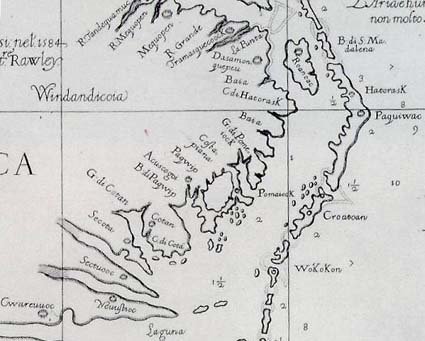
I’ve been looking forward to today for 2 years now. Anne and I are going to Hatteras Island which is where Croatoan is located. Croatoan, if you recall, is the location that the Lost Colony carved on the post and the tree at Fort Raleigh as a message to John White telling him where the colony had removed to. He found it on his return voyage in 1590 and was thrilled that the colonists were among the friendly Indians headed by Manteo, their friend who had gone with them to England twice.

John White was also greatly relieved by what he did not find; no cross. Their agreement was that if the colonists left under duress or in distress, they would carve not only their location, but a cross. There were no crosses anyplace, and the houses had been disassembled and removed, not ransacked, so their move was obviously orderly and planned, not hurried.

John White wanted to visit Hatteras Island, they called Croatoan, but a violent storm interfered with is plans, drowned some of the men, and nearly sank their ships. They had to abandon those plan and return to England. So close, yet so far away.

Anne and I retraced that journey today. After leaving Roanoke Island, we crossed the bouncing bridge and turned onto NC 12. NC 12 is the ribbon highway that runs the length of Hatteras land for more than 50 miles. The island starts out running North to South, but does a dog-leg turn in about 45 miles at Buxton and then runs East to West. The North to South portion is generally not inhabitable. Now of course there are a couple of tiny villages with a few hearty souls who must not need insurance who have built right on the sand dunes on the ocean on a tiny spit of land not more than an eighth of a mile wide in some locations. But these locations do not support any agriculture because there is only sand and no dirt. In fact, these areas are quite picturesque. The park service has erected sand fences in some areas to attempt to reduce erosion and the sand drifts around the fences. However, the road has been washed out many times and new inlets through the island are often created during hurricanes and other bad storms, letting us know indeed how fragile those islands truly are.

In some locations, maritime forest exists on the islands. While this is different than mainland forests, it’s still beautiful and often blocks the view of the ocean making the distance to the ocean from the road seem far greater than it is.

This site has beautiful photos of the Outer Banks. Take a look and share the unique charm and the stark beauty. You can see Maritime forest in many of these photos.

http://www.duke.edu/~jspippen/vistas/outerbanks.htm


We stopped in Buxton and visited Scott Dawson at the Croatoan Inn. Scott and his wife own the inn and Scott has a beautiful collection of Native artifacts found on the beaches and elsewhere on Hatteras Island.

http://www.thecroatoaninn.com/

Scott is a wealth of information about the history of Hatteras Island. He is passionate about the colonists who he believes assimilated with the Indians. Indeed, they told us they were going to Croatoan and Hatteras Island is Croatoan. This part of Hatteras Island is the first location between Roanoke and the end of Hatteras Island that can sustain a population and grown food, and the Indians have inhabited that island at least seasonally for thousands of years.

Scott has done a great deal of research on the topic and his book “Croatoan, Birth Place of America” is now in its second printing.

http://www.buybooksontheweb.com/product.aspx?ISBN=0-7414-5469-6


We had read the book and wanted to see the area for ourselves as well as some of the landmarks Scott discussed in his book. Even though he couldn’t leave the hotel and go with us, he was kind enough to tell us how to locate several items, including the Cora tree.

The Cora Tree and the coffins are in very close proximity. The coffins were, unfortunately, reburied many years ago, right after they were accidentally excavated by a drag line operator before anyone realized the significance of what he had stumbled upon. However, we do know the general area where the canal digging as going on and the Cora tree is in the same vicinity.

The Cora tree is quite interesting, although maddeningly inconclusive just like so much else about the Lost Colony. Recalling that the colonists were to carve the location of where they were moving on a tree or post, this tree is over 1000 years old, so even in 1600 or so it would have been remarkable. At that time it was already 600 years old, a substantial tree.

Did the colonists carve a second message to their hoped-for rescuers after they moved to Croatoan? Were they trying to tell John White where they went if they moved a second time? Is Cora similar to Coree? The locals tell the story that
Cora was a witch who was hung in the tree and lightening carved the name Cora in the bark.

From there Anne and I drove around the area where we knew the coffins to have been, and revisited the sites of earlier archaeological digs, although there have been very few on Hatteras Island, with most digs being focused on Fort Raleigh and that area. Earlier digs on Hatteras (Croatoan) were very successful, unearthing a gunlock and the Kendall family signet ring among other English items. In the 1930s, a man found a sword in that area as well. Again, while confirming the presence of the English on the island, it doesn’t confirm that the colonists themselves were there and that that they weren’t later artifacts. Kendal was in the 1585-86 military expedition, but not in the 1587 group, so we may be finding artifacts from the military expedition, not the colonists themselves.

How I would love to test the DNA of the skeletal remains in those caskets. It could potentially tell us a great deal about what happened between 1587 when the colonists moved to Croatoan and the next “sighting” we have directly of their descendants which is in 1701 when John Lawson visits the Hatteras Indians and reports that they have grey eyes and some have light hair as well. The Hatteras told Lawson that their ancestors were white people and talked in books. The Hatteras also tell of a ghost boat which appears on misty nights and is Raleigh’s boat which has come for them.

How many misty and foggy nights indeed did the colonists spend watching for any sign through the mists of their rescuers? Did they every give up waiting? At some point, had they assimilated so well into the Native culture that they no longer wanted to be rescued? Did they in fact survive to have descendants in the present generation, or did they survive only long enough to be annihilated by disease or warfare with other warring nations and the white settlers as well during the long and bloody Tuscarora War and preceding events?

After some artifact hunting on the beach, from which we turned up empty handed, we ate at a place that passes for fast food. Let’s just suffice it to say it took as long to get a salad, burger and piece of pizza as it would have taken to wait on a table at the nicer restaurant (20 minutes) and have ordered and eaten a dinner. Let’s just say that calling the food mediocre would be doing it a favor. That restaurant is definitely on my “never again” list.

Our drive home was in the dark, and it’s amazing just how dark dark is on the island. Of course, there are no street lights and in the areas with no habitation, there is also no ambient light. The mainland is often out of sight and if you look eastward of course there is just ocean and more ocean. Anne and I watched the ocean and wondered if Hurricaine Bill will cause severe rains and flooding, but this evening, and for a couple of more evenings, Hurricane Bill isn’t a problem. But one this is for sure on the Outer Banks, if this hurricane misses you, there’s always another one waiting in the wings. The surfers count on that.

We arrived home under the poplar tree quite late, for the last time for me. I packed and got my car ready to load in the morning. I slept restlessly trying to decide whether to risk the traffic by going north by Washington DC or take the longer route westward and up 77. By 4:30 AM or so, I had come up with a compromise plan which took me north to Richmond they west on 64 which should keep me out of traffic and rain with little backtracking. My GPS this morning was not happy with my decision. How I just love having a bossy woman in my car. I swear she sounds more disgusted with every direction of hers that I don’t follow. She gets confused sometimes and got herself all bolluxed up near Richmond, nearly sending me to Washington DC in spite of what I told her to do.

This morning when I woke up, I looked out the bedroom window to see condensation running down the window….and it wasn’t raining. It was just that humid. No need to dry your hair here, because it’s going to be wet again in 2.7 minutes. And makeup – only waterproof. But none for me thank you…..I got over that about the same time I got over staying up late.

As I was loading my car for my final trip across the bouncing bridge, Turkey Lurkey ran up and offered some parting advice….I’m not sure I understood her correctly, but I think it was something about not celebrating Thanksgiving this year.


Read all posts in the Trip to Roanoke series:


© History Chasers


Click here to view all recent Searching for the Lost Colony DNA Blog posts

Bookmark and Share

Saturday, August 22, 2009

Roanoke Island Trip - Day 4


Wednesday – Day 4 - August 19th


After staying up way too late last night at the cast party, we slept a little late this morning. I can’t remember the last time I as up till 3AM for a positive reason! However, even with nothing stronger than water to drink, I could certainly feel the late night this morning. How did I ever think this was fun when I was younger?


By noon, Anne and I were absorbed in acid free boxes chocked full of surprises at the Outer Banks History Center. Anne focused on contributed genealogies of Outer Banks families and I was overwhelmed with the magnitude of the Elizabethan Collection, a 16+ box (think banker’s boxes) collection of information collected by research here and overseas that was connected with the preparations for the Roanoke Decoded conference which took place in the late 1990s. After the conference, all the prep was contributed and is now available for researchers. If you’re going to work with that collection, I suggest a day per box minimum, so plan on going to NC for a month as the center is only open Monday through Friday 9-5. Of course you’ll have to amuse yourself in the evenings and weekends while waiting for the center to reopen. Now what better excuse could you have for a month in NC?


I made another important discovery today. There are no quilt shops on the Outer Banks. Now you’d think with nearly 100 miles of ribbon-like highway and thousands of tourists on that one highway, at least some of them would be quilters and would want to take home more than a shirt, a sunburn and some sand in their shoes for souvenirs. Apparently not, because there not only aren’t any quilt shops, there aren’t even any plain old vanilla fabric stores. Hello, how can you live without JoAnne Fabrics? The closest store is at the far northern end of the Island where Kitty Hawk in located and is a WalMart with a very limited selection. No mind though, because I found some pink pirate material that will just have to suffice for my NC souvenir fabric. Talk about things that shouldn’t be pink, but it’s now “unique” and I like that. As far as I’m concerned a quilt shop located beside a Starbucks would be quite the ticket, and of course there are no Starbucks either. Is anyone listening out there….here’s an economic stimulus suggestion for someone!!!! Let me tell you, there are still tourists in NC and they are still spending money.


When visiting the Outer Banks, you have to stop at Kitty Hawk Kites. Kitty Hawk Kites is quintessential Outer Banks. Where is Kitty Hawk Kites? Everyplace. There are many of the stores and yes, they have just stunningly beautiful kites. One thing the Outer Banks always has is wind…and it‘s so hot there that you’ll be exceedingly grateful for that wind, let me tell you. So it’s also a kite flyer’s dream and even if you can’t fly a kite, you can there. There’s no way you can’t fly a kite on the shore line, so indeed, go fly a kite.


http://www.kittyhawk.com/


I was looking for a particular t-shirt. I bought the long sleeve version 2 years ago, and I wanted a short sleeve one as well. It says “don’t ask the locals for directions, they’ve lost one colony already”! Yep, my kind of place. Of course, sale is the word that Americans are in love with so if you tell them the second t-shirt is on sale, you’ll sell 2 for sure. My second (half price) t-shirt says something akin to “Woman who behave don’t make history”. In honor of the fabric, it’s kind of coral colored and has a small insignia size pirate skull and crossbones on it. I’m liking my pink pirate fabric better already. I always love visiting Kitty Hawk Kites! It’s a vacation for your inner child.


By now, I’m late for dinner. If you love seafood, the Outer Banks is the place for you and Beach Road which runs along, you’ve guessed it, the beach, is polka dotted with wonderful local hole-in-the-wall restaurants. Actually, its official street name is Virginia Dare Trail, but it’s always been called Beach Road down there and the locals and any tourist there for more than 24 hours still call it Beach Road.

We ate at the Beach Road Grill, a long-time local favorite and had their house-special steamed and spiced shrimp, served hot with drawn butter and cocktail sauce, along with black beans and rice. Their black beans and rice are served half on one side of the dish and half on the other (rice on one end and beans on the other) with hot salsa across both halves. Nothing like this up north, I guarantee you. Lovely waitress as well. Southern hospitality at its best. The harmonica player was going to start shortly, but we were just too tired to stay up late again, so we left amidst a beautiful sunset, crossed the bouncing bridge, watched the lightening over the sound above Manteo and went home under the poplar tree and called it a night.


http://www.thecoastalexplorer.com/BeachRoadGrill/


Read all posts in the Trip to Roanoke series:


© History Chasers

Click here to view all recent Searching for the Lost Colony DNA Blog posts

Bookmark and Share

Wednesday, August 19, 2009

Happy Birthday, Virginia Dare!!!


Roberta Estes and Anne Poole

Day 3 – August 18th – Tuesday

HAPPY BIRTHDAY VIRGINIA DARE!!!!

Little Virginia could never have imagined the impact she would in a misty and uncertain future. We don’t even know that she even lived past a few days of age, so her future might have been very short. Then again, if she lived to a ripe old age, she could have lived to be 70 or 80 years old. In fact, the Lumbee have a story that tells us that Virginia Dare is buried in Robeson County. Is it true? Well, it could be, assuming of course that she lived. We do know from historical records that there were people living in the Robeson County area as early as 1654. A surveyor entered the area to survey and got himself run off by a group of people with guns. Seems they didn’t want the land they were living on surveyed.

But the Virginia Dare we are all familiar with is the child, the baby, born on August 18th, 1587, to her young mother, Eleanor White Dare, wife of Ananias Dare shortly after landing on Roanoke Island. A marker at Fort Raleigh today commemorates her birth, but looks for all the world like a tombstone.

The Virginia Dare Faire at Fort Raleigh is always free and fun. Today’s event included the Kitty Hawk Kite Company, face painting, a balloon artist, Pizza Hut with free samples, the cast cruising about in costume, singing, dancing, juggling swords, playing “old games” with visitors and more throughout the park. Of course, we had our table there among the festivities as well.

We were fortunate that 2 of our members, Aleda Bunch and Jeri Evans, joined Anne and I for the day. There were lots of questions to be answered as many people stopped by and we needed the help, but more importantly, we go to know each other and had a lot of fun. We were also pleased to discover that two couples came specifically to talk to our group, but most people had a more general curiosity.

Interestingly enough, one of the most interested individuals was a young tour guide who works at Fort Raleigh. He had excellent questions for us and made me wish it was the beginning of their season, not the end. I think though that the Lost Colony is now under his skin, so to speak, and he will carry it with him in many ways for the rest of his life.


Anne talking to visitors


I must say that I don’t think I’ve ever met a nicer group of young people. Most of the staff there consists of college students. All of them were friendly, polite and some were genuinely interested in our project. They smiled and were engaging and helpful. And I must add that most were dressed in stifling wool costumes, floor length, long sleeves, and they must have been miserably hot. We were sweating like faucets stuck “on” and we certainly weren’t in authentic period costumes. Bravo to them for their sunny dispositions!!!

We decided that everyone must want to be an Indian in the cast, because although Ananias Dare is clearly a “leading man”, the Indians are much more comfortable in their costumes. The Queen passed through and traditionally cuts the birthday cake for Virginia Dare, but surely no one wants to wear her wardrobe in hot sultry August in NC.


http://www.thelostcolony.org/

After the Faire ended, Anne and I visited with Doug Stover, the Cultural Resource Manager at Fort Raleigh. Said another way, Doug is the historian and a font on knowledge. Doug was very gracious and spoke with us along with curator, Jason Powell for quite some time. We’re very pleased to continue to work with Fort Raleigh and the National Park Staff.

Tomorrow we’ll be using another local resource, the Outer Banks History Center. While Fort Raleigh involves archaeology, the Lost Colony, military colonists and the later history of the property, the Outer Banks History Center is administered by the North Carolina State archives and includes information on genealogy and family histories. Anne and I are hopeful that we can find some information directly related to the early families on Hatteras Island. We have a “hot lead” to follow!


http://www.obhistorycenter.ncdcr.gov/

Tonight, we travel the road beside the swamp to the stop light at the intersection of the bouncing bridge, back to Manteo, through the tree lined streets with names such as Grenville, Amadas and Ananias Dare. We return to the Fort Raleigh, not as workers, but to attend the play. This is Anne’s 52nd year attending the Lost Colony play. She has missed a few years, but not many. Jeri Evans told me today that her parents were at opening night in 1937. We’ll be asking these ladies to share their very special memories with us in a future blog. Tonight, we’re just going to enjoy this year’s rendition of the play, always slightly different, always wonderful.

Two years ago, we were invited to a very special event after the play. It has now become a tradition that we look forward to every year. Traditionally, Virginia Dare’s birthday is either the last production or the next to last production of the play for the season. Dignitaries are present, of course, and there are special events and awards to the actors and crew who deserve outstanding merit.

One of the most special events is the cast party after the play behind the stage. The area behind the stage is directly on the sound. Parts of the stage are built on a deck that is extended over the sound, and the sand in front of the stage is truly beach sand. By the time the play is over, darkness has fallen and thankfully, the heat has diminished a bit. Volunteers and local businesses provide food for the cast, staff and volunteers, and everyone sits together at picnic tables, visits and of course eats wonderful home-made southern food. (Anne is taking ham, green beans (with bacon fat of course), potato salad (a southern must) and Scotch Cake (some kind of the most wonderful smelling chocolate concoction). Cast members have created their own entertainment, sing, dance, so skits and entertain themselves and others as well. They have become family, indeed, throughout the summer and although we were not family members, they welcomed us warmly into their world. What a beautiful end to the perfect day, looking over the sound, watching the stars, the moon rising over the water and knowing that whether the Colonists survived and moved on or died on Roanoke Island, we’re sharing the same sand, land and stars, a few generations and 422 years removed.


Read all posts in the Trip to Roanoke series:


© History Chasers
Click here to view all recent Searching for the Lost Colony DNA Blog posts

Bookmark and Share